Cook County has 84 designated 2027 Opportunity Zones. By Census internal points, 56 are inside Chicago and 28 are in 22 suburbs, six of them in Harvey. All 84 are Non-Rural. A tract can straddle the city line, so an address needs its own check. The designations take effect in January 2027.
CHICAGO, Ill. — Cook County has 84 designated Opportunity Zones for 2027, and 56 of them are inside the city of Chicago. The other 28 are in 22 suburbs, six of them in Harvey, according to Opportunity Zone Invest’s Census internal-point analysis of the CDFI Fund’s final list. All 84 tracts are Non-Rural. The governor’s November 5 release announced the 240-tract Illinois total and did not break the list down by city.
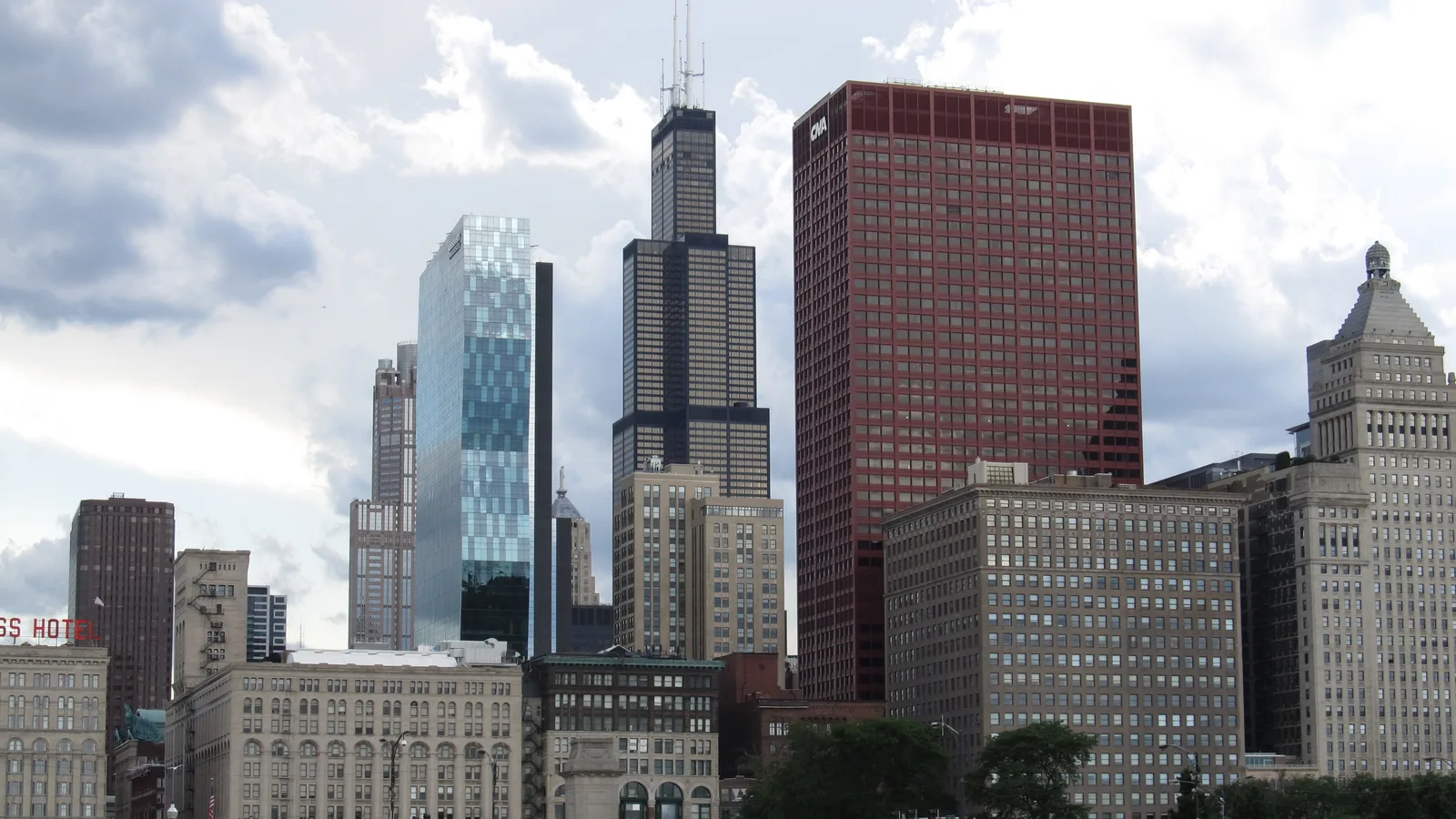
Lead photo: the Chicago Loop skyline from Grant Park, with Willis Tower and the CNA Center, photographed in June 2013. City-context photograph; it does not show a designated tract. Credit: Ken Lund / Wikimedia Commons, CC BY-SA 2.0; cropped and resized.
Cook County has 84 of Illinois’s 240 designated tracts, or 35 percent. Treasury’s October 30, 2026 eligibility file lists 482 eligible tracts in the county. The county’s count is down from 181 on the 2018 list; that comparison is already public and is not the news here. Thirty-five of the 84 tracts carry the same 11-digit GEOID as a 2018 Cook County zone, 25 in Chicago and 10 outside it. The 2018 list uses 2010 tracts, so a matching number does not always mean a matching footprint.
The 28 Cook County tracts outside Chicago, 22 municipalities in all:
| Tract | GEOID | Municipality | Poverty rate |
|---|---|---|---|
| 8269.01 | 17031826901 | Harvey | 32.8% |
| 8269.02 | 17031826902 | Harvey | 32.3% |
| 8271 | 17031827100 | Harvey | 29.1% |
| 8273 | 17031827300 | Harvey | 36.2% |
| 8274 | 17031827400 | Harvey | 25.6% |
| 8275 | 17031827500 | Harvey | 9.5% |
| 8290 | 17031829000 | Chicago Heights | 57.5% |
| 8291 | 17031829100 | Chicago Heights | 29.9% |
| 8233.02 | 17031823302 | Alsip | 8.4% |
| 8051.07 | 17031805107 | Arlington Heights | 14.3% |
| 8212 | 17031821200 | Blue Island | 15.8% |
| 8237.03 | 17031823703 | Bridgeview | 17.6% |
| 8260 | 17031826000 | Calumet City | 33.6% |
| 8230.01 | 17031823001 | Chicago Ridge | 21.7% |
| 8142 | 17031814200 | Cicero | 15.0% |
| 7705 | 17031770500 | Elk Grove Village | 14.0% |
| 8113.02 | 17031811302 | Franklin Park | 22.9% |
| 8287.01 | 17031828701 | Glenwood | 22.0% |
| 8277 | 17031827700 | Hazel Crest | 28.3% |
| 8047.01 | 17031804701 | Hoffman Estates | 9.1% |
| 8284.02 | 17031828402 | Homewood | 19.2% |
| 8113.01 | 17031811301 | Northlake | 6.9% |
| 8302.02 | 17031830202 | Park Forest | 26.9% |
| 8272 | 17031827200 | Phoenix | 13.2% |
| 8248 | 17031824800 | Posen | 20.3% |
| 8302.01 | 17031830201 | Richton Park | 10.7% |
| 8112 | 17031811200 | River Grove | 15.5% |
| 8296 | 17031829600 | Steger | 15.0% |
Source: CDFI Fund final list, Treasury’s October 30, 2026 eligibility file (ACS 2020–2024) and Opportunity Zone Invest’s Census internal-point analysis. Treasury’s file leaves the median family income ratio blank for six designated Cook County tracts, including Harvey 8273 and 8274, because median family income is missing; Treasury flags all six as eligible.
Harvey has the most of any suburb, six tracts, with poverty rates from 9.5 to 36.2 percent. Chicago Heights has two. Each of the other 20 municipalities in the table has one tract.
Treasury treats a tract as an eligible low-income community if its poverty rate is at least 20 percent and its income ratio is no more than 125 percent, or if the income ratio is 70 percent or less. Fourteen of the 28 suburban tracts have poverty rates under 20 percent and qualify on income, as do 12 of the 56 Chicago tracts. The Chicago tracts are listed on the Cook County tract list and the Cook County zone page.
DCEO Director Kristin Richards said in the governor’s November 5 release, “Through a data-driven evaluation and extensive statewide engagement, we identified 240 census tracts with potential to attract new investment, support business growth, expand economic opportunity, and strengthen local economies.” The release does not discuss individual Cook County tracts or municipalities.
What this means for investors
A Cook County address, or even a Chicago address, is not automatically in a zone. Status is set by 2020 census tract, not by city limits or ZIP code. A tract can straddle the city line: the federal list has 84 Cook County tracts, and the Census check places 56 inside Chicago, but that does not say a given address is in or out. Confirm a parcel with the Census Bureau address lookup, the census tract lookup or the map. The 28 suburban tracts are a separate investor map from the 56 in Chicago.
What happens next
The designations take effect in January 2027, under Treasury’s November 5 announcement and DCEO’s release. The next test is whether developers, lenders or local governments name projects in the Chicago and suburban tracts. A designation does not pay for, permit or build anything on its own.
Related. Cook County Opportunity Zones · Illinois Opportunity Zones · All state Opportunity Zone pages · Cook County tract list · Designated-tract final list · Designated-tract map · Census tract lookup · Opportunity Zone extension guide · Treasury designates all 6,576 Opportunity Zone 2.0 tracts on its final list
Reporting note: Poverty rates were read from Treasury’s October 30, 2026 eligibility file, which uses ACS 2020–2024 data, and rounded to one decimal place. Designated and 2018 tract counts were counted from the CDFI Fund final workbook and the December 14, 2018 CDFI designated-QOZ list. City assignments are Opportunity Zone Invest’s Census internal-point analysis of all 84 tracts, not a statement that any tract lies entirely inside a municipality’s limits. The quote is from the governor’s November 5 release. No outreach and no independently conducted interviews. Educational reporting, not tax, legal or investment advice.
FAQ
How many of Cook County’s 2027 Opportunity Zones are in Chicago?
Fifty-six of 84, by Opportunity Zone Invest’s Census internal-point analysis. The other 28 are in 22 suburbs, including six in Harvey and two in Chicago Heights.
Is every Chicago address in a designated tract?
No. Status is by 2020 census tract, not by city limits or ZIP code, and a tract can straddle the city line. Check each address with the Census Bureau address lookup or OZI’s tract lookup.
Are any Cook County tracts Rural?
No. All 84 designated Cook County tracts are Non-Rural on the CDFI Fund’s final list. Illinois has 78 Rural tracts among its 240.
How many Cook County tracts are eligible but not designated?
Treasury’s October 30, 2026 file lists 482 eligible tracts in Cook County, so 398 are eligible but not designated.
When do the 2027 designations take effect?
January 2027. Illinois announced its 240 tracts on November 5, 2026, the day Treasury announced the final national list.
- gov-pritzker-newsroom.prezly.com, as of November 16, 2026
- home.treasury.gov (1), as of November 16, 2026
- cdfifund.gov (1), as of November 16, 2026
- cdfifund.gov (2), as of November 16, 2026
- home.treasury.gov (2), as of November 16, 2026
- geocoding.geo.census.gov, as of November 16, 2026
- cdfifund.gov (3), as of November 16, 2026
Original reporting by the Opportunity Zone Invest Editorial Team for Opportunity Zone Invest, an independent OZ 2.0 research site. Facts are drawn from the primary sources cited above per our editorial standards. Nothing here is tax, legal, or investment advice. Found an error? See our corrections policy or write to Opportunity Zone Invest.
OZ tools: Opportunity Zone calculator · OZ 2.0 designation checker · 180-day rule calculator · Form 8997 instructions · Form 8996 instructions · all tools
Get OZ 2.0 updates
OZ 2.0 news, guidance, and key deadlines. Unsubscribe anytime.