The former Landmark Mall site in Alexandria, Va., redeveloped as WestEnd with a future Inova hospital, stays in a 2027 Opportunity Zone. Here is the data.
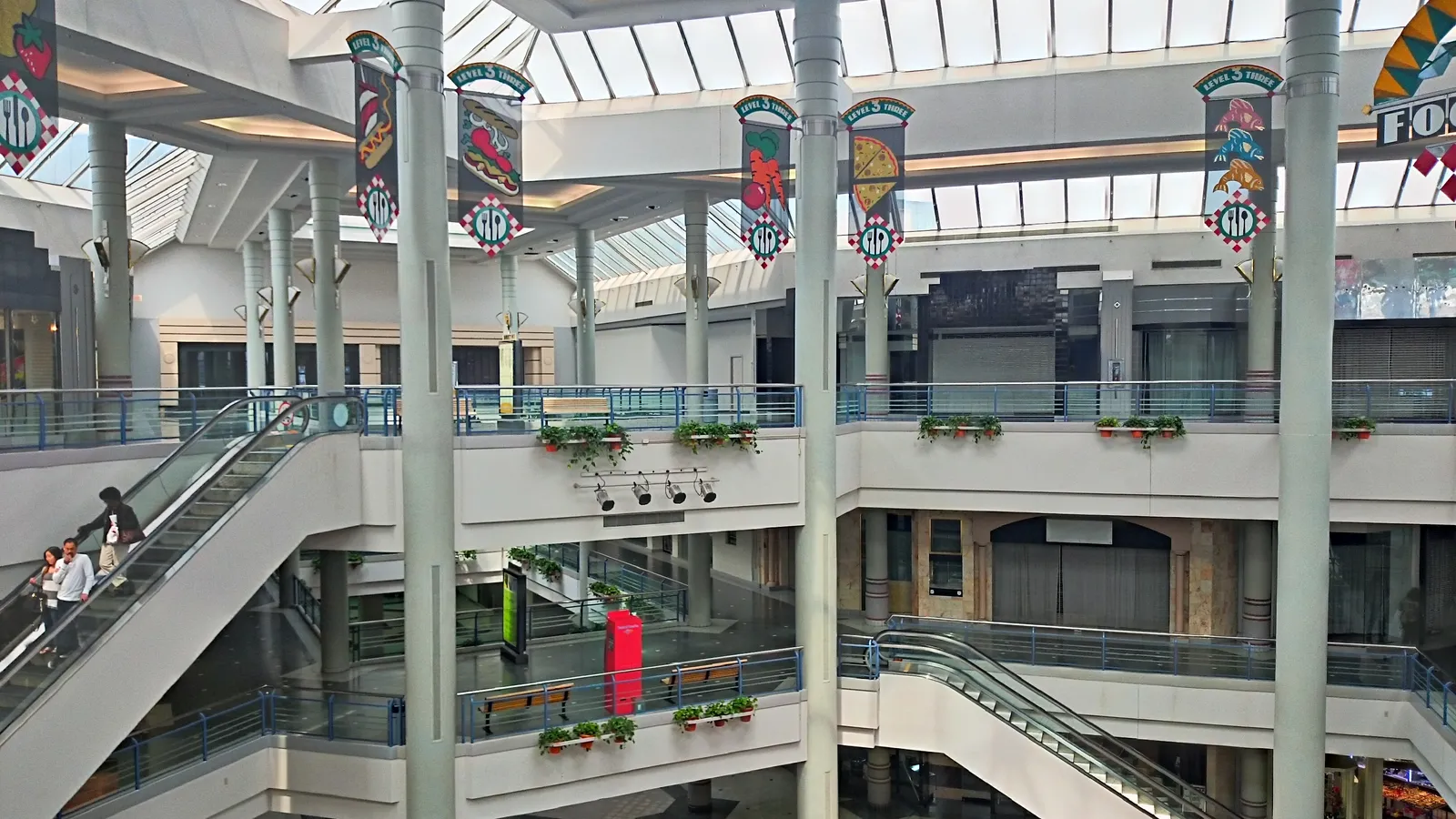
ALEXANDRIA, Va. — A photograph taken inside Landmark Mall in April 2015 shows three levels of skylit atrium, escalators running and only a few shoppers riding them. Seven years later, cranes were taking the building apart.
On the same ground off Duke Street and Interstate 395, the structure of a 192-bed hospital now stands at full height. And on November 5, the census tract under all of it was named to Treasury’s final list of Opportunity Zones.
Tract 51510200304 is one of three Alexandria tracts on the CDFI Fund's final designation workbook. Census Bureau geocoding puts 5801 Duke Street (the mall's old address), 6001 Duke Street (the Inova hospital parcel) and 5725 Duke Street inside it. The designation takes effect January 1, 2027 and runs ten years.
For the site that became WestEnd Alexandria, this isn't new. Under the 2010 census map, the tract containing those same addresses, 51510200303, was one of four Alexandria tracts on the program's original 2018 list. Census tract lines were redrawn after 2020, and the numbers changed with them. The status of the land under the mall carried over.
Photo: Landmark Mall's interior on April 15, 2015. Credit: Payton Chung / Wikimedia Commons, CC BY 2.0; cropped and resized.
A $100,000 neighborhood that counts as low-income
Opportunity Zone eligibility is relative. Under the second-round rules, a tract in a metro area qualifies if its median family income is no more than 70 percent of the metro figure, or if its poverty rate is at least 20 percent and its income is no more than 125 percent of that benchmark, according to Treasury's published eligibility method. Tracts outside metro areas are measured against the state.
In the Washington metro area, the benchmark is high. Treasury's eligibility data sets the metro median family income at $154,653. Tract 2003.04 reports a median family income of $100,000, which is 64.7 percent of that figure, along with an 18.5 percent poverty rate. It is a six-figure tract that still clears the low-income bar.
The other two Alexandria tracts on the final list show the same arithmetic. One, 2001.04, carries the same tract number as one of the 2018 zones:
51510200104 (tract 2001.04), along North Beauregard Street near Seminary Road and the Mark Center: median family income $65,886, or 42.6 percent of the metro figure; poverty rate 19.5 percent
51510200406 (tract 2004.06), bounded by I-395, Duke Street, South Van Dorn Street and Yoakum Parkway: median family income $74,556, or 48.2 percent; poverty rate 2.8 percent
All three are non-rural. Together they held about 11,900 residents at the 2020 census.
Now compare the hospital Inova is leaving. Its campus at 4250 and 4320 Seminary Road, a little under two miles northeast, falls in tract 51510200202. Treasury's data lists that tract's median family income at $250,000, the ceiling of the Census Bureau’s estimates, and its poverty rate at 1.7 percent. It is not eligible. In October, NVR Inc. filed a concept plan with the city for a townhouse community on the old hospital land, consistent with a 2021 rezoning, according to the city's project page.
So the hospital is moving from a tract at the very top of the federal income data to one that qualifies as low-income. The townhouses will rise where the incentive does not reach.
What the city has already put in
The incentive is landing on a project the public has been underwriting for years. On July 6, 2021, the Alexandria City Council voted unanimously for the redevelopment agreements for the mall site that allow up to roughly four million square feet of development, according to the city's Landmark/Van Dorn page. Foulger-Pratt is the developer. The city committed $54 million in public bond funds to buy land it leases to Inova, plus $123.6 million in bonds for site preparation and infrastructure. Those bonds are to be repaid from the site's future tax revenue, backed by special assessments in a community development authority district. The city projects a net gain of $810 million over 30 years and says the hospital will bring more than 2,000 health care workers to the campus.
Inova marked the "topping out" of the Alexandria campus in April. Its announcement lists 192 licensed beds in private rooms, cardiac and neurosciences care, women's health, a standalone Inova Schar Cancer center and outpatient specialty services. The opening is planned for 2028.
"It will be an employment magnet," Inova CEO Dr. J. Stephen Jones said in June of the $2.5 billion going into the Alexandria hospital and a sister campus in Franconia-Springfield, ALXnow reported.
How Virginia chose
Gov. Abigail Spanberger announced on November 6 that Treasury had designated all 153 tracts in the state's slate. Her office said localities ranked their eligible tracts and submitted details on "development activity, zoning alignment, community support, feasibility, and investor interest." The state's Department of Housing and Community Development and the Virginia Economic Development Partnership reviewed them against four focus areas: housing development, downtown revitalization, business-ready investment and regional asset development.
"I worked closely with local leaders across Virginia to make sure we supported the priorities that mattered most to local communities," Spanberger said in the release.
Measured against those criteria, the Landmark tract had a strong file: a site already zoned, a public financing structure in place and an anchor institution under construction. ALXnow's Emily Leayman noted on November 9 that one of the new zones covers the WestEnd project.
What the designation can and can't do here
The hospital’s opening doesn’t depend on the designation; its structure topped out in April. The incentive's practical reach is the rest of WestEnd and the blocks around it: the residential, retail and office parcels that still have to be financed one by one within the development envelope the city has already set. It also reaches the neighboring apartment and townhouse projects the city has signed off on along Stevenson Avenue and Holmes Run Parkway. Whether any of that capital is structured as Opportunity Zone investment will show up only in future project financings, not in this week's map.
The data also raises a question it can’t answer. A tract with a $100,000 median family income is low-income only because the region around it is so expensive. That is how the statute works, and in Northern Virginia it means a federal incentive will sit alongside a project the city has already backed with $177.6 million in bonds.
Checking a specific site
Corridor names and neighborhood labels are not boundaries. Before relying on Opportunity Zone status for a parcel near Landmark, confirm its census tract with the OZI designation checker or the tract lookup. Then compare it against the final list and the Alexandria tract list.
What happens next. The designation of tract 51510200304, and of the other two Alexandria tracts, takes effect January 1, 2027 and runs ten years under Treasury's November 5 final list (sb0682). Inova’s Alexandria campus is planned to open in 2028; the hospital’s opening does not depend on the designation. Whether capital for the rest of WestEnd is structured as Opportunity Zone investment will show up only in future project financings.
Eleven years after that photograph of a quiet atrium, the mall is gone. The tax status of the land under it has stayed the same.
Related. Virginia’s designated Opportunity Zones · Alexandria Opportunity Zones · Richmond’s eight new zones · Southern states’ designated Opportunity Zones · National final-list coverage · Opportunity Zone tax-benefit guide
Reporting note: Tract assignments for 5725, 5801 and 6001 Duke Street and 4250 and 4320 Seminary Road come from the Census Bureau geocoder (current and 2010 vintages). Both Seminary Road addresses fall in tract 51510200202; the straight-line distance from 5801 Duke Street to 4320 Seminary Road is 1.59 miles northeast (1.66 miles to 4250). The 2018 comparison uses the CDFI Fund's December 2018 designated-tract list. Census tract boundaries changed between 2010 and 2020, so the 2018 and 2027 tracts are not identical areas. Income and poverty figures come from Treasury's October 30, 2026 eligibility workbook (2020–2024 American Community Survey five-year estimates), and population figures from the 2020 census. City financing figures and the $810 million projection are the city's own and were not independently audited. Quotes are from published releases and attributed reporting. OZI did not interview city, state or Inova officials for this article. A tract designation is not an endorsement of any deal. This is educational reporting, not tax, legal or investment advice.
- home.treasury.gov (1), as of November 13, 2026
- cdfifund.gov (1), as of November 13, 2026
- home.treasury.gov (2), as of November 13, 2026
- governor.virginia.gov, as of November 13, 2026
- alxnow.com (1), as of November 13, 2026
- alexandriava.gov (1), as of November 13, 2026
- alexandriava.gov (2), as of November 13, 2026
- inovanewsroom.org, as of November 13, 2026
- alxnow.com (2), as of November 13, 2026
- home.treasury.gov (3), as of November 13, 2026
- cdfifund.gov (2), as of November 13, 2026
- geocoding.geo.census.gov, as of November 13, 2026
Original reporting by the Opportunity Zone Invest Editorial Team for Opportunity Zone Invest, an independent OZ 2.0 research site. Facts are drawn from the primary sources cited above per our editorial standards. Nothing here is tax, legal, or investment advice. Found an error? See our corrections policy or write to Opportunity Zone Invest.
OZ tools: Opportunity Zone calculator · OZ 2.0 designation checker · 180-day rule calculator · Form 8997 instructions · Form 8996 instructions · all tools
Get OZ 2.0 updates
OZ 2.0 news, guidance, and key deadlines. Unsubscribe anytime.